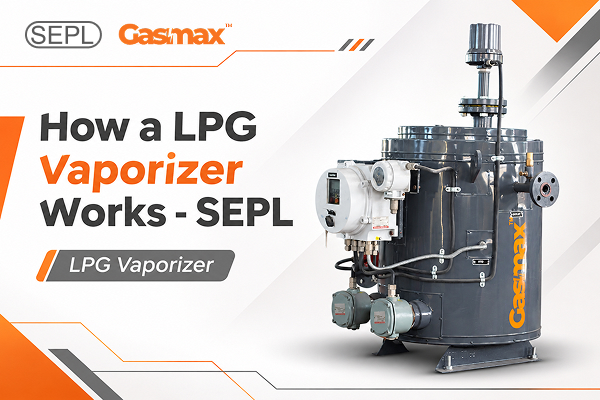
Liquid Petroleum Gas (LPG) is stored in liquid form inside storage tanks. However, many industrial and commercial applications need LPG in gas form to operate. An LPG vaporizer makes this possible by using heat to convert liquid LPG into gas. It then supplies the gas to the connected equipment at a controlled pressure and temperature.
At Saraswat Engineers Pvt. Ltd. (SEPL), we manufacture LPG Vaporizers for different industrial and commercial requirements. Our range includes different designs and heating methods to support a steady gas supply. Understanding how these systems work can help you choose the right model for your application.
What Is an LPG Vaporizer and Why Is It Needed?
An LPG vaporizer is a system that changes liquid LPG into gaseous form before it reaches the point of use. It supplies gas to equipment that needs a controlled and continuous fuel supply.
When LPG moves from a storage tank, it enters the vaporizer in liquid form. The system transfers heat to the liquid, allowing it to change into gas. The vaporized LPG then moves through the outlet to the connected equipment.
We offer vaporizers for applications where natural vaporization may not meet the required gas demand. These systems support different operations, including:
-
Industrial heating and processing
-
Power generation
-
LPG storage and distribution
-
Chemical processing
-
Commercial kitchens
-
Automotive LPG fueling stations
The required capacity and operating conditions help determine which vaporizer design is suitable for a particular application.
How Does the LPG Vaporization Process Work?
The basic working process involves receiving liquid LPG, applying heat and supplying the resulting gas to the required equipment. The exact heating method depends on the vaporizer design.
The process generally follows these steps:
-
Liquid LPG Entry: LPG enters the vaporizer from the storage tank through the inlet connection.
-
Heat Application: The system uses a suitable heat source to transfer heat to the liquid LPG.
-
Heat Transfer: The LPG absorbs heat through a coil, heat exchanger or heating chamber, depending on the model.
-
Vaporization: The liquid LPG changes into gas after absorbing the required heat.
-
Pressure Regulation: The system manages the gas pressure to support the required supply conditions.
-
Gas Outlet: The vaporized LPG moves through the outlet and reaches the connected equipment.
Temperature and pressure controls help manage this process. Their purpose is to support controlled vaporization and a steady gas supply.
What Heating Methods Do Our LPG Vaporizers Use?
Different LPG vaporizers use different methods to transfer heat. The choice depends on the model, application and operating requirements. Our range includes water bath and dry-type vaporizers, while our ambient vaporizers serve cryogenic gas systems.
Here is how these methods work:
-
Water Bath Heating: An electric heater, steam coil or gas burner heats the water inside the system. The heated water transfers heat to liquid LPG through submerged coils or heat exchangers. The LPG absorbs this heat and changes into gas.
-
Dry-Type Heating: Electrical heating elements or another external heat source apply controlled heat to LPG. The process does not use water or steam for heat transfer. Thermostat-controlled elements help manage the heating process.
-
Ambient Heating: These systems use natural heat from the surrounding air. Aluminium finned tubes and heat exchangers absorb heat from the air and transfer it to the cryogenic liquid, converting it into gas.
Each method has different operating needs. Water bath models use the heat stored in water to support stable vaporization. Dry-type models do not need water replenishment. Ambient systems use surrounding air and need open space with proper airflow.
What Controls and Safety Features Help Manage the Process?
Temperature, pressure and liquid supply need proper control during vaporization. Our LPG Vaporizers include different controls and safety features based on their design.
Our water bath models use PID temperature control to manage the water bath temperature and LPG input. Their safety features include:
-
Pressure relief valves
-
Low water level protection
-
LPG liquid level switches
-
Controlled LPG supply
-
Pressure switches
-
PESO-approved explosion-proof electrical panels
Our dry-type models use thermostat-controlled heating elements. They also include pressure relief valves, temperature sensors and emergency shutdown systems.
Our GasMax™ range highlights pressure, level and temperature sensors. We also use automated safety interlocks in our vaporizer systems. These features support controlled operation and help manage the gas supply.
Where Are LPG Vaporizers Used?
LPG vaporizers support different operations that need gas as a fuel or process input. Their capacity and design can vary based on the application.
We offer vaporization systems for several uses, including:
-
Manufacturing: Supports industrial heating and processing requirements.
-
Power Generation: Supplies gaseous fuel to equipment used for power generation.
-
Chemical Processing: Supports processes that require a controlled LPG supply.
-
LPG Distribution: Helps convert stored liquid LPG into gas for distribution.
-
Hospitality: Supports gas requirements in commercial kitchens.
-
Automotive: Serves applications such as LPG fueling stations and forklifts.
Our range includes different capacity options to support varied gas requirements. Water bath models offer capacities from 20 kg/hr to 2,000 kg/hr, while dry-type models range from 10 kg/hr to 5,000 kg/hr, depending on the model.
How Can We Help You Choose the Right LPG Vaporizer?
The right vaporizer depends on your required gas capacity, operating pressure, heating method and application. You should also consider the available installation space and the operating conditions at your facility.
At Saraswat Engineers Pvt. Ltd. (SEPL), we manufacture GasMax™ vaporizers for commercial and industrial use. Our range includes different models and capacity options to support varied gas supply needs. We also manufacture LPG storage systems, cylinder manifolds, safety valves and other gas-handling equipment.
With more than 5,000 installations across India and 12 international markets, we support industrial gas requirements across different sectors. Our engineering work focuses on safety, compliance and reliable operation.
If you need an LPG vaporizer for your facility, share your application and gas demand with us. We can help you understand our available models and choose a suitable system for your requirements.